Florence was beautiful, beautiful art, buildings and food.
 |
| Piazza della Signoria |
 |
| A bridge over the Arno |
I stayed at a hotel right on the Arno River and level with the Ponte Vecchio, the old medieval bridge, that has several dozen jewelers shops built along it and many tourists. I stayed on the Palazzo Pitti side of the bridge so of course I visited the Renaissance palace that housed the Medici’s from 1549. Because of a staff strike (the guide books say they are frequent), I didn’t get to see everything in the palace but I did get to view the Palatine gallery which contains many masterpieces owned by the Medici. There are paintings by Raphael, Titian and others but my favorite in this gallery is the Filippo Lippi (1406 - 1469) work: Madonna with Child. Despite the child Jesus not looking quite right, mother Mary has a very sweet face.
_-_WGA13238.jpg/318px-Fra_Filippo_Lippi_-_Madonna_with_the_Child_and_Scenes_from_the_Life_of_St_Anne_(detail)_-_WGA13238.jpg)
The Palazzo Pitti has a garden that climbs the hill behind the palace and feels very quiet and peaceful away from the rest of the city, especially on this hot day. Back in the day, when the Medici wanted to get from their palace to their offices across the bridge in the city, they needn’t go outside. Cosimo Medici I had an enclosed corridor built for the family that connected the Pitti Palace with the Old palace, the Palazzo Vecchio and the Uffizi offices.
Now a gallery, the Uffizi is enormously popular and even though I have a pre-booked timed ticket I still have to line up to get in. Most people inside are crowded around the Botticelli’s. There is the Birth of Venus, featuring the golden tressed goddess Venus standing in a clam shell as she is blown to the shore of Cyprus by the windy breath of Zephyrus, god of the west wind.

And Primavera, or the Allegory of Spring featuring Venus in a garden with the nymph Chloris who Zephyrus turns into the goddess Flora, the three Graces dancing, a cherub and Mercury.
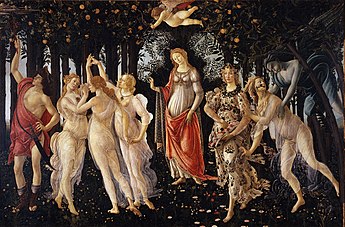
Both paintings are pretty and beautifully composed, just a pleasure to look at. The Venus is thought to be modeled on Simonetta Vespucci, the most beautiful woman in Florence who the artist Sandro Botticelli (1455-1510) was in love with.
And Primavera, or the Allegory of Spring featuring Venus in a garden with the nymph Chloris who Zephyrus turns into the goddess Flora, the three Graces dancing, a cherub and Mercury.
Both paintings are pretty and beautifully composed, just a pleasure to look at. The Venus is thought to be modeled on Simonetta Vespucci, the most beautiful woman in Florence who the artist Sandro Botticelli (1455-1510) was in love with.
Another Venus at the Uffizi is by Titian (1490-1576), the stunning Venus of Urbino.

And in another part of the gallery are the Caravaggio’s: Bacchus and the scary head of Medusa on a wooden shield.

The Accademia di Belle Arti (Academy of Fine Arts) was another of the museums I visited which really was a ‘must do’ because of Michelangelo’s David. Before visiting the Accademia, I had already laid eyes on the replica of the five metre marble statue in the Piazza della Signoria.
 |
| The replica David |
This public square outside the Palazzo Vecchio is adjacent to the Loggia dei Lanzi, an open-air sculpture gallery displaying numerous Renaissance and Roman sculptures. In fact the sculpture in the Loggia is fascinating: there is a powerful 1545 Cellini bronze sculpture of Perseus holding the head of Medusa and the multi-dimensional Rape of the Sabine Woman (1574-1582) by Giambologna: it seems to have no front or back, every perspective is equally compelling. You can see why these sculptures are special: you can’t take your eyes off them and have to keep walking around them.
 |
| Rape of the Sabine Woman |
The Duomo, Basilica di Santa Maria del Fiore, the main church of Florence is kind of where the Renaissance all began. The sculptor Lorenzo Ghiberti (1378 - 1455) won a contest in 1401 to create new doors for the baptistery. Despite taking over twenty years to sculpt the doors, he won a second commission to sculpt another set of baptistery doors which were so spectacular Michelangelo called them the ‘Gates of Paradise.’ These had ten panels depicting scenes from the Old Testament. He sculpted scenes on the doors’ panels of never seen before realism using only recently discovered techniques of perspective. The figures seem to emerge from the panels in gold (bronze really). Exquisite. The second set of doors took Ghilberti 27 years, so the baptistery doors were his life’s work really. Now the doors in situ are replicas, the real ones are in the Duomo museum (and I didn’t get to see them as they were refitting the display).
 |
| Duomo |
 |
| The Gates of Paradise |
The Uffizi and Accademia and the Duomo were the most important museums or monuments in Florence but really the art is everywhere. I visited an old monastery, San Marco where a talented monk, Fra Angelico (1395-1455), had spent years painting frescos in every cell, frescos in the cloister, an altarpiece commissioned by Cosimo Medici, and illuminated manuscripts.
There were hardly any tourists at San Marco which gave it a peaceful ambience and the frescos seemed so fresh, not like they were 600 years old. I also saw here Cosimo Medici’s cell: he used to visit San Marco for private meditation. Later the cell was used by Girolamo Savonarola (1452–1498), the severe prophesying and moralizing Dominican friar who believed man was wicked, he preached reform of the Catholic Church and commanded the Bonfire of the Vanities where art and books were publicly burned. He had a large following and was an enemy of the Pope and if he had his way, perhaps the Renaissance would have been upended and Florence would have retreated back into the Middle Ages. Eventually, he was excommunicated by the Pope, called a heretic and hanged. At San Marco, I saw scraps of what is believed to be his hair shirt.
.jpg) |
| One of Fra Angelico's frescos |
In the Bargello, a former prison and now an important Renaissance sculpture museum, there is Donatello’s effeminate bronze David and Michelangelo’s fatty fat fat drunk Bacchus. As Bacchus is the God of wine, Michelangelo created a realistic marble sculpture, that is nothing like his athletic warrior David. Realistic in that the god of wine is likely to be fleshy not fit, boozed up not brawny, clumsy not cut. It’s not elegant.
 |
| Michelangelo's Bachus |


The city is pretty, gorgeous terracotta colours, and although it was hot while I was there, I needed to walk off all the food I ate and so I loved this sunset walk up a hill to take in a view of the city. Really makes me want to see more of Tuscany.


No comments:
Post a Comment