


The Shooting
Madrid is very very hot and dry. In the Plaza Mayor, the city’s largest square where overpriced restaurant tables sprawl the pavement, electric fans are fitted with plumbing that sprays out cooling mists of water to thwart spontaneous combustion of diners. My hostal room is clean, basic and doesn’t smell but has no air-conditioning. At night if I open the shutters and window onto the small balcony there is a minimally effective breeze though I have to sleep with a pillow over my head to allay the noise of the late night partying Madrileño s. At 1:45am, I am completely over the noise and get up to close the shutters at which point exactly, three gun shots ring out – BANG! BANG! BANG! Rather than duck for cover I rush to hang over the balcony to witness the action in the street below. Seven policia municipal cars arrive, an hysterical woman is screaming hoarsely and stamping her feet flamenco style and I wait and wait for a bloodied corpse to be pulled from the bar or the perpetrator to be tackled and shackled and thrown into the policia hatchback. The policia scour the road with torches for bullet shells and there is much standing around with hands on hips. Soon I am bored. An anticlimax, perhaps some pseudo bravado act of firing into the air and no gunman, no victim to be seen.
Museo Del Prado
It is one of the greatest public collections of paintings in the world and rather large.Five hours I am there and I have to have my audio guide batteries changed twice. The museum was first opened to the public in 1819 under the patronage of King Ferdinand VII and consists of the collections of the Monarchs who ruled Spain from the 15th century onwards. The Spanish paintings collection is the largest in the museum and it’s quite exciting to discover works by great Spanish artists such as Velázquez, El Greco and Goya. The most famous painting in the museum is Las Meninas by Diego Velázquez (1599-1660). It’s complicated and full of activity. The central subject is the 5 year old Infanta Margarita, a pretty blonde porcelain skinned child wearing an elaborate gown with a wide framed hoop petticoat as was the ridiculous court fashion, and being doted on by her maids of honour. I feel sad for this overdressed child who later in her short life, at only 15 years of age is betrothed to her ugly maternal uncle and paternal cousin, Leopold I, Holy Roman Emperor, giving birth to six children and then dying at 21. Also quite creepy but incredibly life-like is Velázquez’s series of realist paintings of court dwarves and buffoons, the physically and mentally disabled who provided entertainment for the royal houses until the start of the 18th century.
 Image via Wikipedia
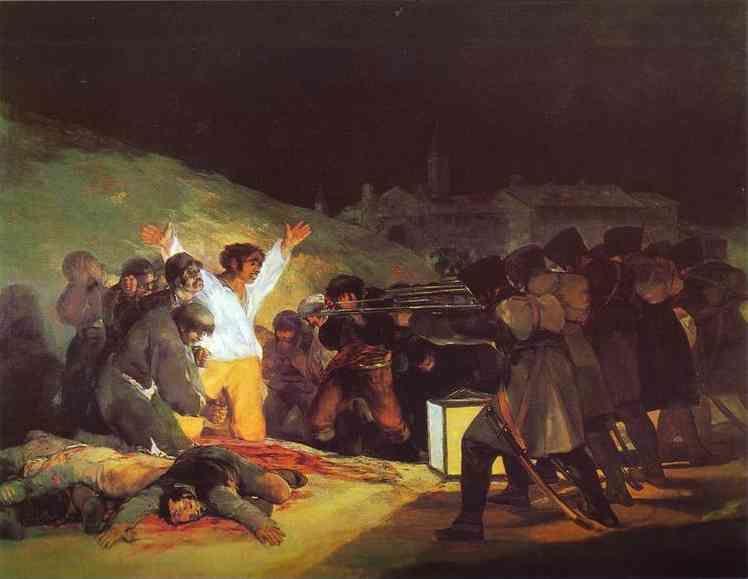
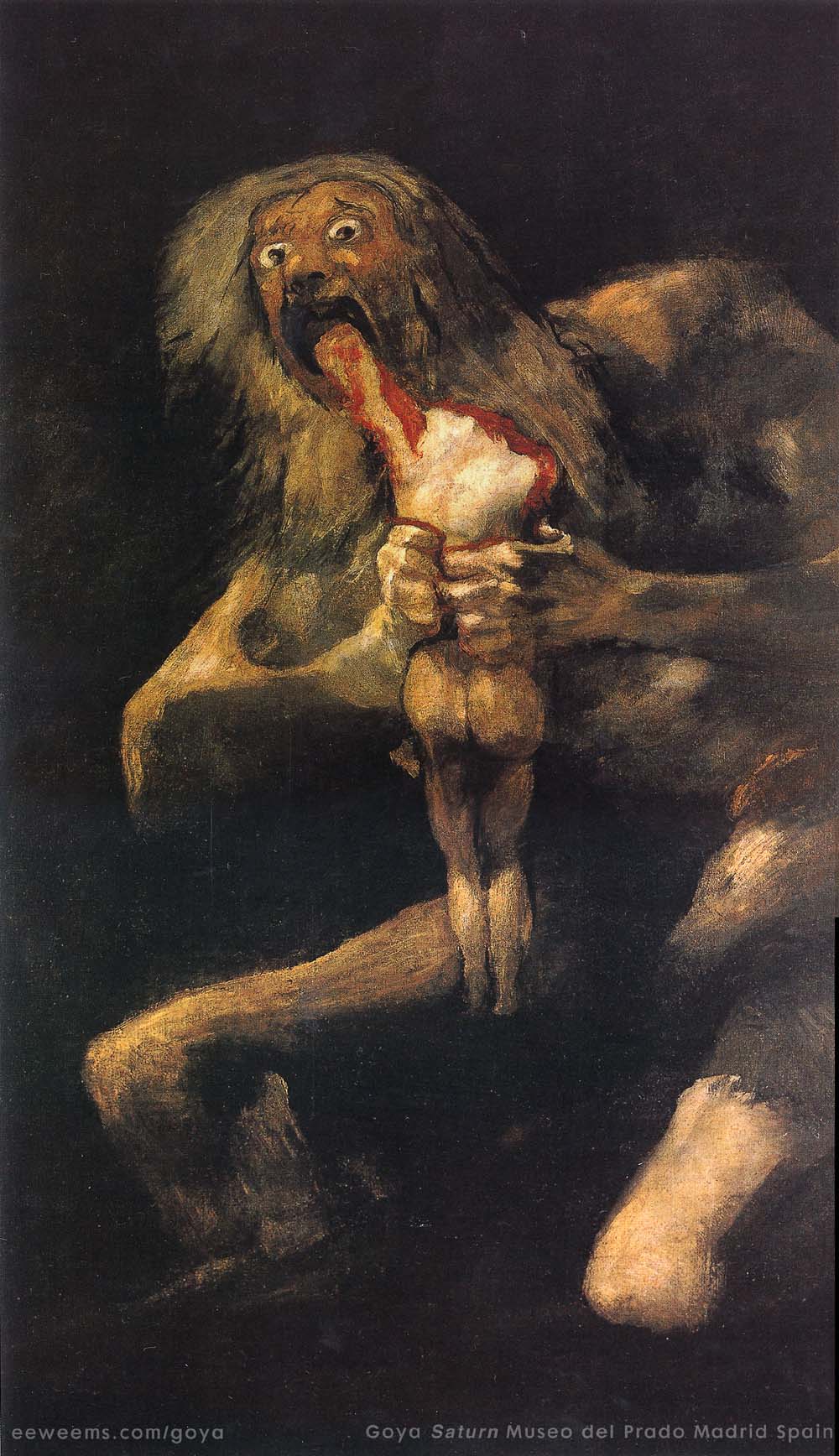
There are more than a hundred and fifty paintings by Francisco De Goya (1746-1828) in the Prado. Goya was initially trained in the flamboyant Rococo style but influenced by Velázquez and then by personal and social political events that took place during his lifetime, he gradually developed his own thoughtful style which became quite dark towards the end of his life. He was a court painter from 1786, became deaf due to an illness in 1793, and endured the Spanish War of independence (1808-14). One famous work Third of May 1808 portrays the atrocious massacre of his countrymen by the French. It’s frightening, dark and bloody. His last works called The Black Paintings are even more morbid and horrific such as Saturn Devouring His Son (not one for the dining room) and the minimalist and disturbing Half Submerged Dog (a sad and lonely image). His much prettier works include The Maja paintings (a nude and clothed version of a mysterious woman which hang together) are famous due to the fact that Goya was called on to reveal the name of the woman who posed for the nude by the Spanish inquisition (the nude genre was banned by the Inquisition).
The Museo del Prado also has hundreds of other masterpieces: Hieronymous Bosch’s (known as El Bosco in Spain) sexually suggestive Garden of Earthly Delights Garden of Earthly Delightshas hundreds of nudies in it’s central panel frolicking embarassingly with fruit, but they will pay in hell for their lustful immorality in the third panel. And there is Rubens, Titian, Caravaggio, Rembrandt .....
The Fugitive
I’m leisurely lolling at an outside table on the Plaza Mayor, committing sins of gluttony. I have a mouthful of fried baby squid dripping in egg yolk in my mouth when I spy the fugitive bolting Usain style across the plaza stuffing a green shopping bag into another bag, frightened eyes, one two, three times checking behind him in a telltale way. I am a thief, a shoplifter, a bag snatcher and the law is after me. There is no time to swallow as two policia on motorbikes circle the plaza and I can clearly see the fugitive behind a pole, catching his breath, his white eyeballs betraying his fear, he takes off again down an arcade. None of the other nonchalant diners have noticed him but I am pointing with my fork and ‘hhmpfing’ through the mouthful of squid “he went that way”. The policia have picked up his scent and they casually motor after him. I’ll never know if he is caught but what entertainment to witness the aftermath of petty crime!
The Music of the Night
As much as I enjoy the ubiquitous piano accordion players in every square, lane, street corner and train of each European city I have visited so far, insofar as street entertainment goes there is much to be said for originality. Madrid excels with it’s freaks, jesters and músicos of actual talent. In Madrid I have seen headless bodies, bodiless heads, a man clamouring irritatingly on various shaped wine glasses (CD available €10), a fellow making bird-monkey sounds, it goes on. But I am struck by a brilliant crowd-stopping flamenco duet in jeans in a laneway late at night– he plucks a softly pitched guitar, she begins a lament with sombre and mournful vocals, gradually escalating to a furious and emotional wail, with foot stamping and staccato hand clapping. So emotional, raw and real.
Modern Art at Museo de Arte Reina Sofia
The Museo Nacional Centro de Arte Reina Sofía is Spain's national museum of 20th century art and it has glass elevators! There are excellent works by Pablo Picasso and the mad Salvador Dali and I discover many other modern artists. Picasso’s Guernica is a huge mural painting in black, white and grey depicting events of the bombing of Guernica in 1937, in the Spanish Civil war. It’s chaotic and terrifying and attracts a crowd. Also I see some great lifelike sculpture by Madrid painter and sculptor Antonio López García (1936). His name means nothing at the time, but later I am on the Puerto del Sol and push through a crowd with policia and TV cameras filming the elderly artist himself painting the square en plein air. Nearby I get some lunch at an authentic locals’ cafe. Cafe El Brilliante has a sign on the wall: Casa funda en 1952, Este local abrio sus puerto en 1961. (House founded in 1952, this place opened in 1961) and hasn’t changed much. The mostly older portly male staff wear monogrammed short sleeve business shirts from 1961 and shout orders over the customers and across the various basic stainless steel counters with stools and argue and joke with exaggerated hand gestures. The most popular item is deep fried calamari on a baguette.
Real Palatial
The Palacio Real (Royal Palace) in Madrid was built over a 26 year period from 1734 and is still used by the King of Spain for state ceremonial activities. It’s gorgeous at night as it’s lit up almost white against a black sky. Inside, I visit 50 of the rooms, all vastly different in their ornamentation and decoration but all tremendously ornate and elaborate. Marble staircases with lion sculptures, gold gilded ceiling frescos, wall tapestries, gilded bronze and crystal chandeliers, gigantic clocks, porcelain decoration, Goya portraiture. The dining room has an enormous table with over a hundred plush dining chairs. The armoury has the 16th century arms collections of Charles V and Phillip II. Ten armed cavaliers on horse statues clutch jousting sticks in the centre of the room. Many of the suits of armour weighing over 40kg are elaborately engraved for parades and jousting contests and there are children’s suits belonging to Phillip IV between the ages of 4 and 14 years of age. Quite cute.
Meat you can Eat (just)
I thought I had ordered a small dish of whitebait for an entree but I’ve hit a language snag and a heap of seasoned pink sausage meat is piled high on my plate which I dutifully consume and dip ripped off pieces of the plate of crusty bread into it’s fatty texture as instructed by the waiter who watches me eagerly. God, please make the main dish small. I have ordered Churrasco something – I think it is a grilled steak. A massive cut of cow arrives on a sizzling hot terracotta plate, so red in the middle it has a pulse. In Spanish (as if I understand) and with a visual demonstration the waiter enlightens me on how to cut and cook the steak on my plate – slice and sear on each side and bring to the mouth. It is a race against time, the hot plate is cooling, I ferociously saw at my steak and as I break to sip some wine, the waiter tut tuts, shakes his head, lurches over to my table and starts to saw his arms in the air: the vibe is ‘keep going’. I’m clearly not fast enough. Soon the terracotta plate no longer sizzles and there is still half a kilo of bleeding animal on it, the waiter gets me another from the kitchen so I have no choice but to go hell for leather again to please him – he seems concerned that I do it right and finish the job. I wolf down bites until I reach the danger zone of satiety. There are intermittent checks. “Bueno?” Yes, it’s good. Am I good? Am I good at this steak cutting and eating? He gives me thumbs up. I am good. I down a swig of wine, quite relieved that the meal is over.
The Operation
“Senorita, no photos” I am warned by one of them. Crouching figures that beckon me are manning at least 10 white square sheets on the pavement of the Puerto del Sol. The sheets have ropes on each corner joined together in the middle and display brand name sunglasses, perfumes, DVD’s, leather goods and watches. The fugitive from the previous night with the white frightened eyes and green shopping bag is there and I watch him take some sunglasses out of the bag and onto the white sheet. His eyes dart around, placing goods on the white sheet, on the white sheet, eyes darting round , he’s seen something, and now placing back in the bag, back in the bag, quickly, drawing the ropes on the white sheet and slinking away. I look around there were ten white sheets - covered in pilfered stuff for sale and now there are none. I turn away into the path of a policia municipal car gliding down the broad street onto the square, then across the square and back onto the road. They saw nothing or turned a blind eye, and as soon as they are gone, the operation is back in place. The crouching figures placing their loot back on the white sheets, summoning passersby.
Instead of the hot stuff I get (and pay for) some real souvenirs. San Miguel is a great handmade ceramics shop run by a young couple passionate about authentic ceramics made in various Spanish regions where I get a pot with a blue and green painted design of birds and flowers. At Tierra, they have Spanish and international artisans create unique jewellery and accessories. The Madrileño s who run these places are very proud of their local crafts and are so friendly but not at all pushy. I buy Sean a poster advertising a bullfight for the well known matador who coincidentally shares his name.




No comments:
Post a Comment